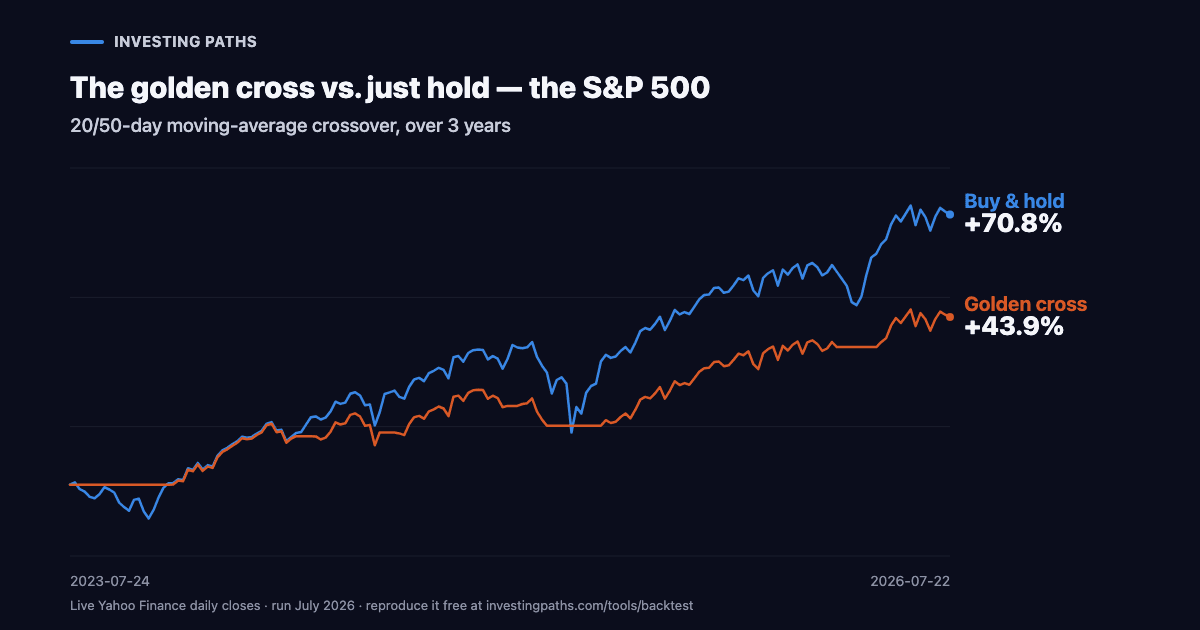
If you've spent any time in trading forums, you've seen it: the "golden cross." When a stock's short-term moving average crosses above its long-term one, you buy; when it crosses back below (the "death cross"), you sell. It sounds disciplined. It has an intimidating name. Charts of it look convincing — after the fact.
So we tested it, mechanically, with no cherry-picking:
Go long while the 20-day moving average is above the 50-day. Sell the moment it drops back below. Sit in cash until the next cross up.
We ran it on nine names — Apple, Microsoft, Amazon, Tesla, Nvidia, Alphabet (Google) and Meta — plus the S&P 500 (SPY) and Nasdaq-100 (QQQ), over one year and three years, and compared it to the strategy that requires zero skill: buy once and hold.
The result: it lost almost every time
| Ticker | 1yr: Cross | 1yr: Hold | Edge | 3yr: Cross | 3yr: Hold | Edge |
|---|---|---|---|---|---|---|
| AAPL | +13.6% | +52.6% | −39.0 | +39.8% | +71.4% | −31.6 |
| MSFT | −19.6% | −22.1% | +2.5 | +0.4% | +15.8% | −15.4 |
| AMZN | −17.2% | +7.6% | −24.8 | +6.5% | +90.1% | −83.6 |
| TSLA | −29.0% | +12.6% | −41.6 | +40.1% | +39.0% | +1.1 |
| NVDA | −3.5% | +27.1% | −30.6 | +205% | +376% | −171 |
| GOOGL | +31.9% | +79.3% | −47.4 | +108% | +184% | −75.5 |
| META | −15.1% | −10.7% | −4.4 | +37.2% | +117% | −79.8 |
| SPY | +9.3% | +20.2% | −10.9 | +43.9% | +70.8% | −26.9 |
| QQQ | +14.7% | +26.3% | −11.6 | +45.7% | +90.8% | −45.1 |
Edge = strategy return minus buy-and-hold. Data: live Yahoo Finance daily closes, run July 2026.
Across 18 tests, the golden cross underperformed buy-and-hold in 16. The only two exceptions — Microsoft over the past year and Tesla over three — scraped ahead by just 2.5 and 1.1 points: rounding-error ties, not edges (Microsoft's during a period when both lost money). It lost to the S&P 500 in both windows, and on Nvidia over three years it gave up an eye-watering 171 percentage points versus just holding.
Why a "smart" rule did so badly
- Whipsaws. In choppy markets the averages cross back and forth, and each false signal means you sell low and buy back higher — bleeding money on the round trips.
- It sits out the best days. The market's biggest up-days often come before the moving average has caught up, so a trend-follower is in cash for exactly the rallies that matter most. Miss a handful of those and your yearly return collapses.
- It's always late by construction. A 50-day average is, by definition, a lagging summary of the past 50 days. It tells you a trend existed — after you've already paid for it.
Is the golden cross useless, then?
Not entirely — and pretending it is would be as dishonest as the hype. Trend-following rules like this one aren't really designed to beat returns; they're designed to reduce risk by getting you out during sustained downtrends. In our tests the rule was often in cash during the worst stretches, so its worst drawdowns were sometimes gentler than white-knuckling a buy-and-hold position through a crash. If your goal is sleeping at night rather than maximising return, that trade-off can be rational.
But as a way to make more money than simply holding a quality stock — or the index? The data says no: of the 18 runs, only two edged ahead of buy-and-hold, and both by barely a point. It never once beat the S&P 500 itself.
The honest fine print
The engine executes at daily closes only, and ignores dividends, fees, slippage and taxes — all of which hit an active rule like this one harder than they hit buy-and-hold. It can only test still-listed tickers (survivorship bias), and past performance predicts nothing. This is an educational tool, not investment advice.
Don't trust us — test it yourself
Maybe a 50/200 cross behaves differently. Maybe it works on an index instead of single stocks. Maybe your favourite ticker is the exception. There's exactly one way to find out, and it's free:
Backtest the golden cross on any stock, free →
Want to test moving-average rules against your own portfolio, or combine them with other signals over longer histories? That's what Pulse is for.
Investing Paths builds honest, free tools for retail investors. Nothing here is investment advice; backtested results are hypothetical and ignore real-world costs. Do your own research.