If you’ve ever heard the phrase “make your money work for you”, it’s probably about compound interest. It’s one of the most powerful concepts in personal finance and investing. But what exactly is it? Why do experts call it the “8th wonder of the world”? And how can beginners actually use it to grow wealth over time?
Let’s break it down in simple, beginner-friendly terms.
What Is Compound Interest?
Compound interest means you earn interest not only on your original money (the principal) but also on the interest you’ve already earned. Meaning you reinvest your earnings and will gain additional profit on that which you will reinvest again and on and on it goes..
In other words, your money makes money, and then that money makes even more money.
Simple Example
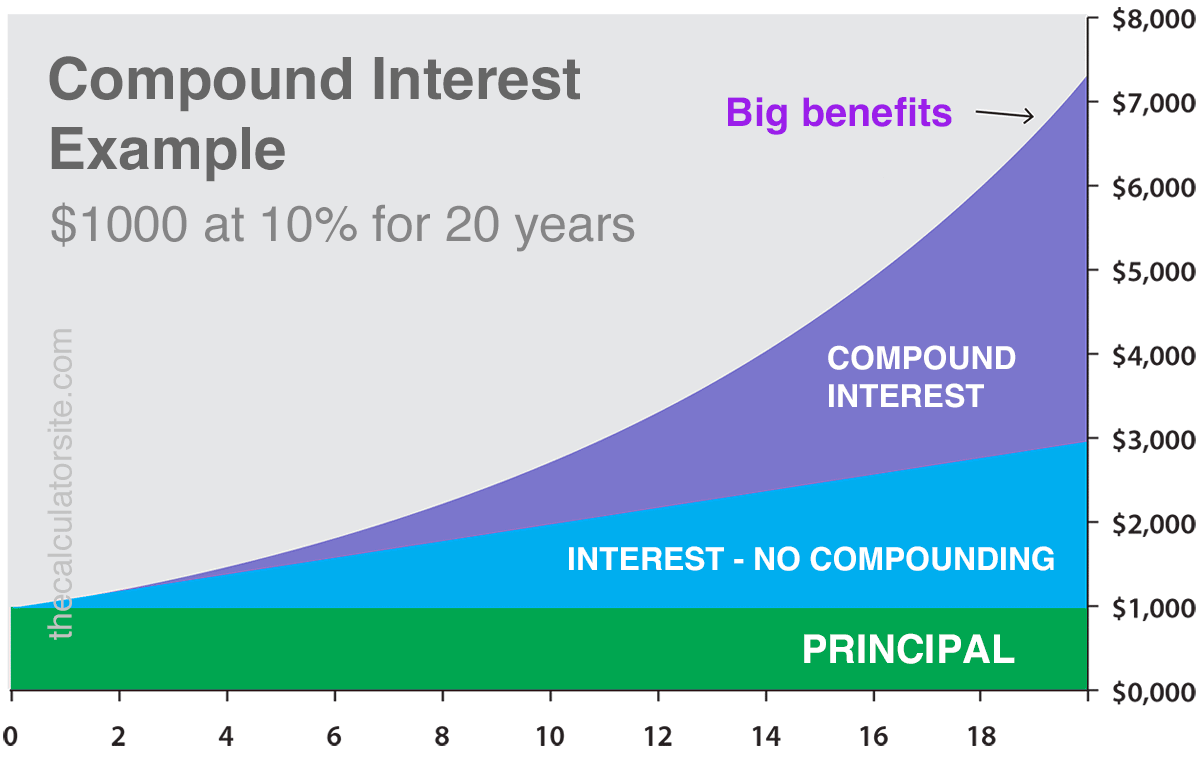
- You invest $1,000 at 10% annual interest.
- After 1 year: you earn $100, balance = $1,100.
- After 2 years: you earn $110 (interest on $1,100), balance = $1,210.
- After 10 years: balance grows to about $2,594.
Notice how the growth accelerates over time – that’s compounding in action.
Historical Examples of Compounding
- Warren Buffett often credits compounding as the core reason behind his fortune – starting investing at 11 gave him more than 75 years of compounding growth.
- A $10,000 investment in the S&P 500 in 1980 would be worth over $900,000 today (assuming dividends reinvested).
- Albert Einstein (attributed quote): “Compound interest is the eighth wonder of the world. He who understands it, earns it; he who doesn’t, pays it.”
Where Do You See Compound Interest?
- Savings accounts (though rates are usually low)
- Bonds and fixed deposits
- Stock market investments (with reinvested dividends)
- Retirement accounts (401k, IRA, etc.)
- Rate of Return
Higher interest/returns = faster growth. (8% grows much faster than 2%.) - Time
The earlier you start, the bigger the snowball. - Frequency of Compounding
Compounded annually, quarterly, monthly, or daily – more frequent = slightly faster growth. - Consistency
Regular contributions (like monthly investing) dramatically boost compounding.
Benefits of Compound Interest
- Accelerated Growth: The longer you stay invested, the faster your money grows.
- Passive Wealth Building: Money grows while you sleep.
- Inflation Beater: Over long periods, compounding in stocks often outpaces inflation.
Risks and Misunderstandings
- Debt Compounds Too: Credit card debt (20%+) is compounding against you.
- Impatience: Early years feel slow – but compounding rewards patience.
- Interruptions: Withdrawing money early kills the compounding effect.
Tips for Beginners
- Start as early as possible – even small amounts add up over decades.
- Reinvest your earnings – dividends and interest should stay invested.
- Stay consistent – automate monthly investments (dollar-cost averaging).
- Avoid high-interest debt – because compounding works both ways.
Conclusion: Why Compound Interest Matters
Compound interest is the ultimate financial superpower. It rewards time, patience, and consistency – three things every beginner can control.
- If you start early, invest steadily, and reinvest your gains, compounding will quietly multiply your wealth in the background.
- The best day to start? Yesterday. The next best day? Today.
Best beginner move?
Open a low-cost investment account, pick a broad market ETF (like VOO or VTI), invest regularly, reinvest dividends, and let compounding do the heavy lifting.
You might enjoy:
How to Build a Simple Long-Term Portfolio